Mix Google Workspace plans on one domain to cut licence costs
Give managers Business Standard and everyone else Business Starter on the same domain. How mixing Google Workspace plans works, what it saves and what it needs.
· Updated · 4 min read
Not everyone in your business needs the same tools. Your management team might live in long video meetings and need plenty of storage, while most of your staff only need email, files and a calendar. Yet most businesses put everyone on one Google Workspace plan, and pay the top price for people who never use the extras.
You don’t have to. Google Workspace lets you run different plans for different people on the same domain. Google calls it partial domain licensing, and for the right business it cuts the licence bill by a third or more.
Can you mix Google Workspace plans on one domain?
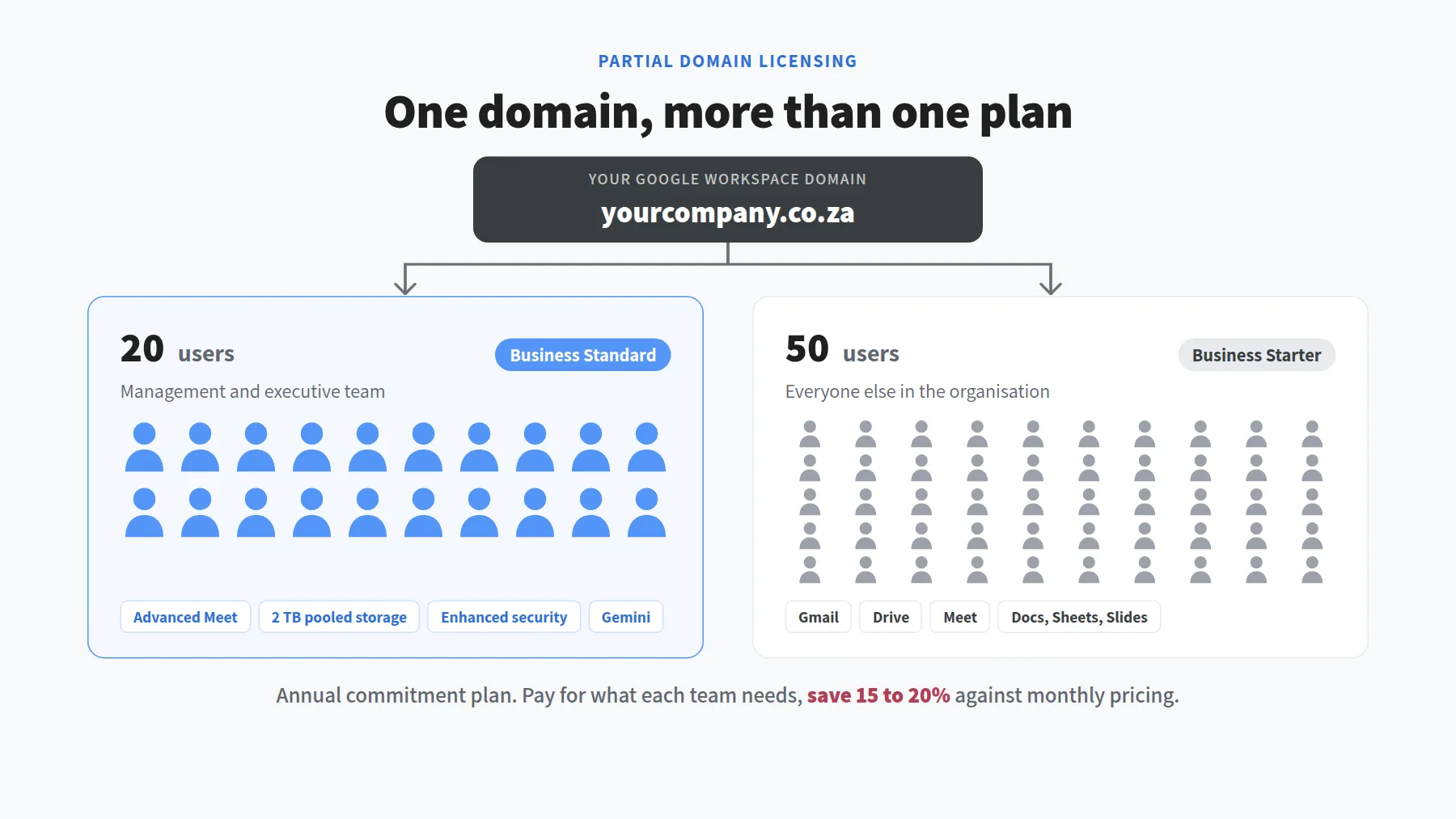
Yes. With partial domain licensing, some of your people can be on Business Standard while the rest are on Business Starter, all on the same company email domain. Everyone still shares one Workspace: the same address book, shared drives, calendars and chat. The only difference is which features each person gets.
If you signed up directly with Google, your whole business is normally on one plan. Mixing plans is set up through a Google Workspace partner such as cozan.
What it saves: a 70-person example
Take a business of 70 people. Twenty managers need the full meeting features and extra storage. The other fifty need email, Drive, Docs and Meet.
| Everyone on Business Standard | Mixed plans | |
|---|---|---|
| Managers (20) | 20 × R275 | 20 × R275 |
| Staff (50) | 50 × R275 | 50 × R135 |
| Per month | R19 250 | R12 250 |
| Per year | R231 000 | R147 000 |
That’s R7 000 a month, or R84 000 a year, for exactly the same team working the same way. Prices are cozan’s annual plan rates per user per month, paid monthly, excl. VAT, as at September 2026. See current Google Workspace pricing.
What each group gets
- Business Standard (for the 20): 2 TB of pooled storage per person, meeting recordings, bigger meetings, and Gemini AI in Docs, Sheets, Slides and Meet.
- Business Starter (for the 50): business email on your domain, 30 GB of pooled storage per person, video meetings, Docs, Sheets and Slides, and Gemini in Gmail.
If someone outgrows Starter, we move them up to Standard. Nothing about their email, files or calendar changes.
What you need to qualify
- An annual plan. Mixing plans is only available on a 12-month commitment, not on flexible monthly billing. You still pay monthly, and the annual rate is about 20% cheaper than flexible anyway.
- A committed number of licences. You’re billed for the licences you commit to at the start of the term, whether or not every seat is in use. So it pays to get the numbers right up front.
- At least two plans. Business Starter with Business Standard is the most common mix, but Business Plus can be part of it too.
Growing during the year
Hiring halfway through the year? Add licences at any time, and you pay for them only from the month you add them to the end of your term.
Example: you commit to 50 Business Starter licences in January and add 10 more in July. You pay for those 10 for the six months left in the term, not the full year.
What you can’t do is drop licences mid-term. You can reduce your count when the term renews, which is why we review seat numbers with you before every renewal.
Is mixing plans right for your business?
It’s worth a look if:
- You have 20 or more people, and a clear split between people who need the full toolkit and people who don’t.
- Your team size is fairly stable, or growing, over the next year.
- You’re currently paying Business Standard or Plus for everyone.
It’s probably not worth it if you’re a small team where everyone uses the same features, or if your headcount swings up and down through the year. Then flexible monthly billing may suit you better.
Common questions
Do people on different plans notice anything? Only in the features they have. They email, share files and meet with each other exactly as before.
Can we change someone’s plan later? Yes. Moving someone up can happen at any time. Moving people down is done at renewal.
We’re already on Google Workspace with someone else. Can we still do this? Yes. We transfer your subscription to cozan without touching your users or data, then set up the mixed plans at the right point in your term. See how moving from another reseller works.
Let us work out the numbers
Tell us how many people you have and roughly who needs what. We’ll model the cost of mixing plans against what you pay now, in rands, and handle the switch for you.